In Ethereum’s PoS Gasper consensus, “Checkpoint justification” is one of the core components of chain security:
Only when at least 2/3 of active validators in an epoch submit attestations pointing to a certain checkpoint will that checkpoint be “justified”.
The Justification withholding reorg attack exploits a vulnerability in this mechanism:
Attackers deliberately prevent the honest chain from collecting enough attestations, keeping the honest chain from justifying checkpoints. Meanwhile, the attackers secretly build a hidden chain and accumulate sufficient attestations. Once the timing is right, they release the hidden chain all at once, directly reorganizing an entire epoch of blocks from the honest chain.
Let’s break down the entire attack process with the accompanying diagram.
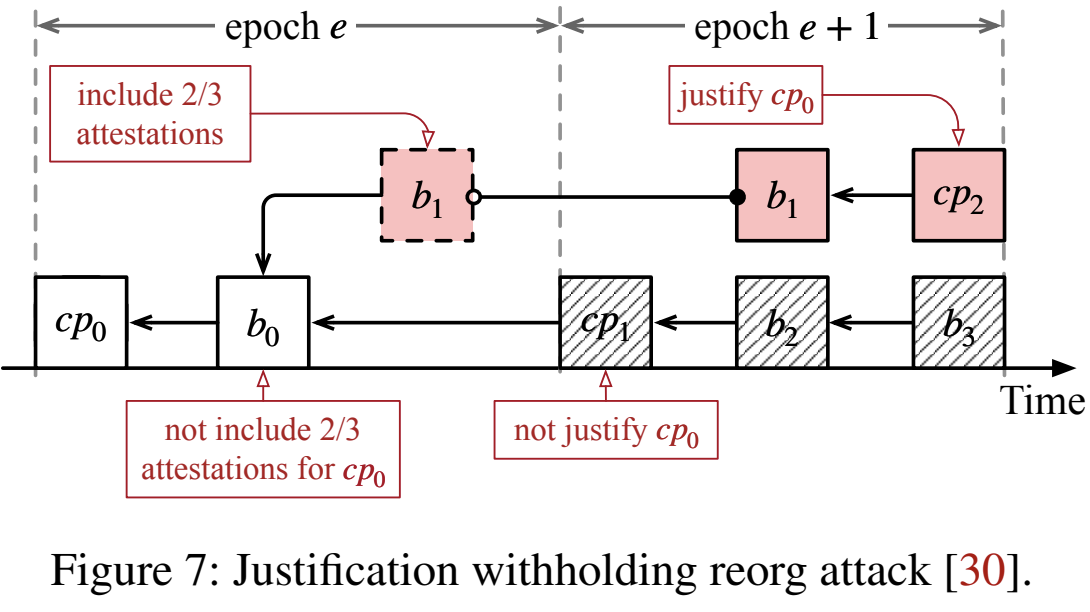
1. Key Attack Strategy:
Prevent the honest chain from justifying cp0; enable the attacker’s hidden chain to justify cp0.
Finally, reveal the hidden chain → reorganize the honest chain.
2. Why Is This Attack So Significant?
A single attack can cause:
- Reorganization of an entire epoch (32 blocks)
- Complete abandonment of all honest validators’ work
- Dramatic weakening of liveness
- Conditions for advanced attacks like MEV reorgs and double-spending
3. Timeline Breakdown (Step-by-Step Explanation with Diagram)
Epoch e: Attack Begins
(1) Honest proposer produces the last public block b0
b0 is the last block produced by an honest proposer in epoch e (white b0 on the left side of the diagram).
(2) All subsequent proposers in the epoch are Byzantine ⇒ “Block withholding” begins
Attacker proposers continue producing blocks, but these blocks:
- Are not broadcast publicly
- Are hidden from honest validators
This forms a “hidden chain” (red dashed line b1 in the upper part of the diagram).
(3) Result: Honest chain fails to get 2/3 attestations ⇒ Cannot justify cp0
Because blocks are hidden on the honest chain, it doesn’t see enough attestations,
therefore cp0 cannot be justified on the honest chain.
Epoch e+1: Honest Chain Continues, But Falls Into the Trap
(4) Honest proposer produces new checkpoint cp1 on top of b0
Since the honest chain hasn’t had blocks withheld from it, the honest chain’s view is:
cp0 → b0 → ... → cp1
But here’s the critical issue:
- cp1 itself cannot be justified (lacking 2/3 attestations from the previous epoch)
- The honest chain still cannot justify cp0
The honest chain becomes “stuck”.
End of Epoch e+1: Attacker Reveals Hidden Chain, Launches Devastating Reorg
(5) Byzantine nodes publish the withheld hidden chain all at once
At this point, the attacker releases:
- The hidden b1
- Checkpoint cp2 built on b1
Moreover, this hidden chain contains 2/3 attestations supporting cp0 (because these attestations were withheld and not published).
(6) Result: Attacker’s chain successfully justifies cp0, while honest chain cannot
In Gasper, justification capability is the decisive factor for checkpoint priority.
When cp2 is published:
Attacker's chain: cp0 → b1 → cp2   (can justify cp0)
Honest chain:     cp0 → b0 → cp1   (cannot justify cp0)
The protocol prefers to select the chain that can justify.
Final Outcome: An Entire 32 Blocks Reorganized
Since each epoch has 32 slots, and the attack spans epochs e and e+1,
almost all blocks from epoch e+1 on the honest chain will be orphaned.
Blocks b2, b3, and cp1 marked with shading in the diagram are all discarded.
4. Why Can This Attack Still Occur in Ethereum 2025’s Gasper?
There are 3 key reasons:
(1) Gasper’s justification completely depends on seeing 2/3 attestations
If attackers prevent the honest chain from receiving them, this is its weakness.
(2) Proposer weight is too significant: later proposers heavily favor the attack
As long as the last few proposers near the end of an epoch are Byzantine:
- They can control block propagation
- They can deliberately withhold blocks
- They can privately collect attestations
- They can create a chain that appears “healthier” than the honest chain
(3) Gasper’s “finality gadget” assumes chains will always receive attestations in time
But in reality: Byzantine proposers may not broadcast blocks.